
Custom Railing / San Jose & South Bay
Interior Stair Railings in San Jose, CA
Trade tired wood spindles for iron balusters, usually keeping your oak handrail and newel posts, or build a new metal or glass stair railing from scratch. Every stair is measured against the 34–38 inch handrail rule and the 4-inch sphere before we quote.
- Licensed & InsuredEvery job
- In-Shop FabricationBuilt to measure
- Free On-Site EstimatesWritten ranges
Interior Stair Railings in San Jose, From Foyer to Loft
We remodel and build interior stair railings in San Jose, and most calls start the same way: a two-story entry with an oak handrail, a pair of chunky newel posts and a row of turned wood spindles that has started to look dated or feel loose. In most of those homes the handrail and newels are sound, so we keep them and swap only the spindles for iron balusters. When the rail itself is the problem, we build a new one in steel, aluminum or glass.
San Jose has a deep supply of these stairs. Census ACS 2020–24 data show about 23% of the city's homes were built in the 1970s, about 12% in the 1980s, 9% in the 1990s and nearly 19% since 2000, with a median year built of 1976. That span covers the split-levels, the two-story production homes and the newer townhomes where most stair railing work happens.
Call (408) 409-8723 for a free in-home estimate, or try the stair setting on our railing cost calculator first.
What's Included in a Stair Railing Project
- A free in-home visit to count balusters, measure handrail height from the nosings and check the landing or loft guard.
- Help choosing baluster style, accent pattern and finish, with samples in hand.
- A written scope that says exactly what stays (handrail, newels, shoes) and what gets replaced.
- Floor and tread protection, dust control and daily cleanup in an occupied home.
- Removal and disposal of the old spindles or railing.
- Optional sanding and restaining of the oak handrail and newels, or painting newels for contrast.
- A final walk-through where we shake-test the rail with you.
Swapping Wood Spindles for Iron Balusters
This is the stair upgrade with the biggest visual change for the money. Here is how it goes.
We start with what stays. Before anything comes out, we check the existing handrail for height, grip size and stiffness, and rock each newel post.
Out with the old. Wood spindles are cut and pulled, and the holes in the treads and the underside of the handrail are cleaned or re-drilled to fit iron.
Fit each baluster. Every iron baluster is cut on site to its own tread. Each one is set into the tread with epoxy, capped with a small shoe that hides the hole, and seated into the handrail above.
Check the spacing. Gaps are set so a 4-inch sphere can't pass, and the triangle between the tread, riser and bottom rail is checked against the 6-inch limit.
If the handrail is loose, too low or too wide to grab, we'll recommend a new rail instead of dressing up the old one.
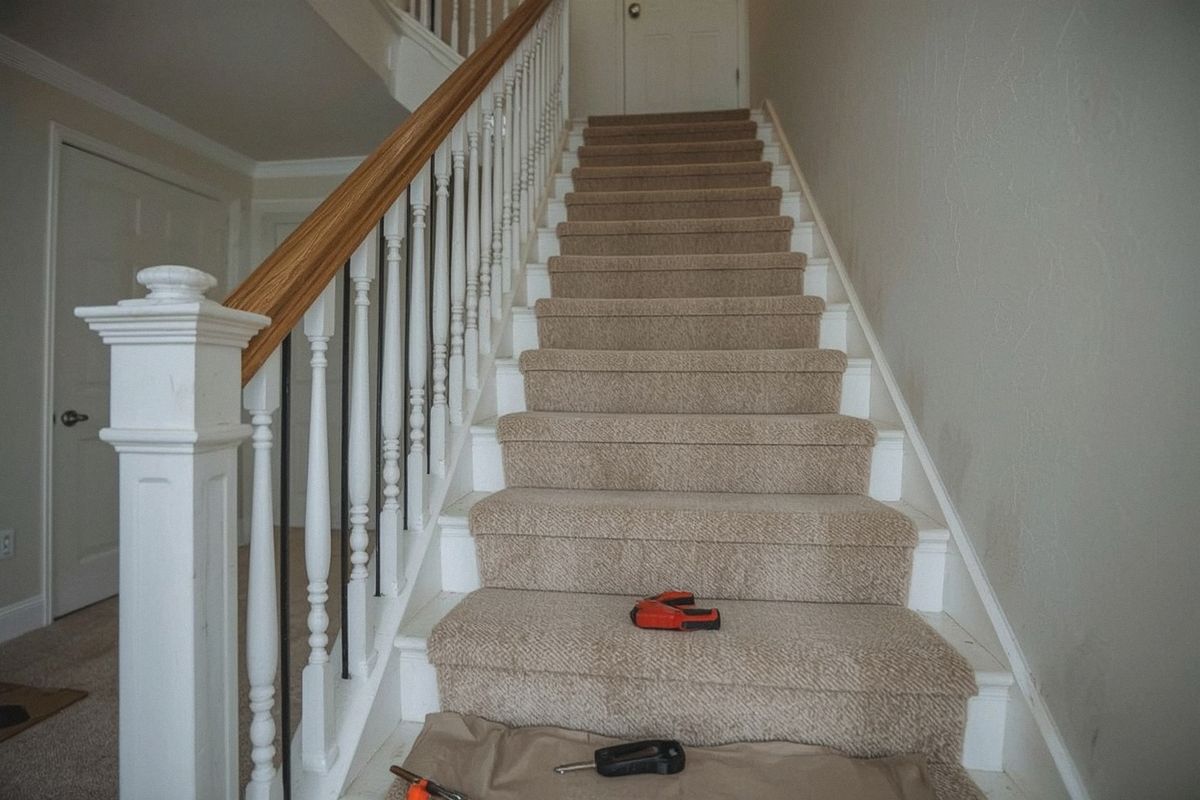
Signs Your Staircase Railing Needs Work
- Spindles that rattle, spin or have pulled out of the handrail.
- A handrail that flexes in the middle of the run, or a newel post you can rock by hand.
- A loft or landing guard that measures under 42 inches, common in homes built under earlier rules.
- Gaps between spindles that would let a 4-inch ball through.
- A wide, flat cap that a child or older adult can't actually wrap a hand around.
Baluster Styles, Handrails and Finishes Compared
| Option | Look | What changes | Typical cost position |
|---|---|---|---|
| Plain square iron baluster | Clean, modern farmhouse | Spindles only; oak rail stays | Lowest of the iron options |
| Single or double twist | Traditional | Spindles only | Low to mid |
| Basket, knuckle or collar accents | Decorative | Spindles, often an accent every third or fourth | Mid |
| New metal handrail and balusters | Contemporary, all metal | Handrail, newels and infill | Mid to high |
| Glass panel loft or stair guard | Open, light | Full railing with clamps or base shoe | Premium |
| Round wall handrail, 1¼ to 2 inches | Minimal | Wall-mounted rail on an enclosed stair | Low |
Iron balusters come in satin black, oil-rubbed bronze, silver vein and other powder-coated finishes. For a modern stair, a horizontal-bar or cable railing is possible as long as it meets the 4-inch rule; cable needs posts about every 4 feet and runs spaced about 3 inches apart to stay tight enough. Compare those options on our cable railing and glass railing pages.
Stair Railing Code Basics for San Jose Homes
Stair handrails sit 34–38 inches above the stair nosing, run continuously along the flight, and use a graspable shape such as a round Type I rail 1¼–2 inches in diameter, mounted at least 1½ inches off the wall. They must resist a 200-pound concentrated load. Open landings and lofts more than 30 inches above the floor below need a guard 42 inches tall, with openings that stop a 4-inch sphere.
Plenty of 1960s and 1970s South Bay homes still have loft guards around 36 inches, built under earlier rules. They aren't automatically illegal, but replacing more than about half of an existing guard is commonly treated as a replacement that must meet today's code, which usually means 42 inches. Ask the building division how your scope will be treated. Our California railing code guide walks through the numbers.
Our Stair Railing Process
Measure the Stair
We count every baluster and record handrail height, landing guard height and grip size.
Pick a Style
You choose balusters, accent pattern and any handrail refinish, with samples in your entry.
Confirm What Stays
We check the kept rail and newels against the 34–38 inch and 4-inch rules before ordering.
Order or Fabricate
Stock balusters are ordered; custom pieces and new rails are built in our shop.
Install
Old spindles come out, iron goes in, and each baluster is set, plumbed and capped.
Walk Through
We clean up, shake-test the rail with you and go over care of the finish.
The Stairs Inside South Bay Homes
1970s homes. San Jose's single biggest building decade was the 1970s, and those split-levels and early two-stories often have a short run of spindles, a low loft guard and wall rails that were never quite graspable.
1980s through 2000s two-stories. This is the classic baluster-swap house: a production-built entry with a stained oak rail and turned spindles, common in Evergreen, Silver Creek, Berryessa and Almaden Valley. The structure is usually fine, which is why keeping the rail and changing the infill is so often the smart call.
Newer townhomes. Milpitas has a median year built of 1987, about 35% of its homes built since 2000, and townhomes make up 20% of its housing. Three-story townhome stairs mean more flights and more landings, so the baluster count, and the price, climbs faster than the floor area suggests.
Interior Stair Railing Cost in San Jose
Interior stair railing work typically runs $40–$100 per linear foot, and a typical stair of about 25 feet lands around $900–$2,500. A straight baluster swap that keeps your handrail sits near $40–$70 per foot, while a new handrail, newels and balusters runs about $60–$100. What moves the number:
- How many balusters, including every landing and loft run.
- Plain balusters versus baskets, knuckles and collars.
- Refinishing or replacing the handrail and newels.
- Curved, winding or three-story stairs that take more fitting time.
- Any permit your scope requires.
Our stair railing remodel cost guide for San Jose walks through sample scopes. For a firm price on your stair, call (408) 409-8723 and we'll come measure it at no charge.
The price estimator needs JavaScript. Call (408) 409-8723 and we'll give you a range over the phone.
Why Choose Us for Your Stair Railing
We Check the Parts You Keep
A baluster swap leaves your handrail and newels in place, so we measure them before we price anything: rail height from the nosing, grip size, landing guard height and every gap against the 4-inch sphere. If a part you planned to keep wouldn't hold up, you learn that at the free estimate along with what it costs to fix, not halfway through the job with half the spindles already out.
Custom Metal From Our Own Shop
Stock balusters cover most stairs, but not every one. When you need a matching newel, a curved section, a loft guard in steel or a full new metal handrail, we fabricate it in our shop with C-23 ornamental-metal craftsmanship and finish it in powder coat. That means one crew handles the whole railing, and the new metal matches the iron balusters beside it instead of looking like a patch.
Tidy Work in a Lived-In House
You live in the house while we work. We cover floors and treads, do the cutting outside or in the garage, keep a clear path for your family, and vacuum before we leave each day. You get one local 408 number for questions from estimate to walk-through, and we're reachable seven days a week, 7am to 6pm, if something comes up in between.
Stair Railing Remodels Across the South Bay
We remodel stair railings across San Jose, in newer townhomes throughout Milpitas, in 1970s two-stories in Campbell and Cupertino, and in larger custom homes in Los Gatos and Saratoga, where older loft guards often need a height check along with the new balusters.
Related Services
Carry the iron outside with wrought iron railings, add an open loft guard through glass railings, see ADA and commercial handrails for office and retail stairs, or fix a wobbly rail with railing repair. Read about our team or book a free stair railing estimate.
FAQ
Questions, Answered
Straight answers on cost, code, permits and materials. Still unsure? Call and ask.
Can you replace wood spindles with iron balusters and keep my oak handrail?
Usually, yes. If the handrail and newel posts are solid and at the right height, we cut out the wood spindles, fit iron balusters to each tread, set them in epoxy under a small shoe and seat them into the existing handrail. We check the rail first and tell you if it should be replaced instead.
How high should a stair handrail be in California?
Handrails go 34 to 38 inches above the stair nosing, run continuously along the flight, and need a graspable shape, such as a round rail 1¼ to 2 inches across mounted at least 1½ inches from the wall. Open lofts and landings more than 30 inches above the floor below need a 42-inch guard.
My loft railing is only 36 inches tall. Do I have to raise it?
Not automatically. Many older San Jose homes have 36-inch guards built under earlier rules. If you replace more than about half of that guard, it's commonly treated as a replacement that must meet current code, usually 42 inches. Ask the building division how your scope will be treated before you plan the job.
How much does it cost to swap spindles for iron balusters in San Jose?
A swap that keeps your handrail typically runs about $40 to $70 per linear foot, and a typical stair of around 25 feet often lands between $900 and $2,500. Decorative balusters, refinishing and extra landings raise the price. A free in-home measure gives you the exact number.
Can I use glass or cable on an interior stair?
Yes. Tempered glass panels and stainless cable both work indoors as long as the openings stop a 4-inch sphere and the posts and handrail meet the height and load rules. Cable needs posts about every 4 feet and runs about 3 inches apart. Both cost more than an iron baluster swap.
Free on-site estimate
Ready to get started?
San Jose Custom Railing designs, fabricates and installs custom railings across San Jose, CA and the South Bay. Licensed and insured, drawings checked against California code, and permit and HOA paperwork handled for you.