
Ten Warning Signs Your Railing Needs Repair or Replacement
Why South Bay Railings Wear Out Quietly
The signs your railing needs repair usually build slowly, so they are easy to stop noticing. Across the South Bay, the housing stock makes this a common problem. About 60% of San Jose homes were built before 1980 (Census ACS 2020–2024), and the share climbs to 69% in Campbell, 71% in Los Gatos and 77% in Saratoga. Many of those railings are original, which means 45 to 60 years of sun, winter rain and settling.
The local climate adds its own wear. Our long dry season shrinks and checks wood rails and loosens the screws that hold them, then the November to April rains soak the cracks. Near the Alviso and Sunnyvale baylands, damp marine air works on bare or thinly painted steel. And the valley sits between the San Andreas fault in the Santa Cruz Mountains and the Hayward and Calaveras faults to the east, so anchorage that is already loose has little margin left.
Here are ten signs to look for, how we decide between repair and replacement, and a simple seasonal routine. If something already feels wrong, call (408) 409-8723.
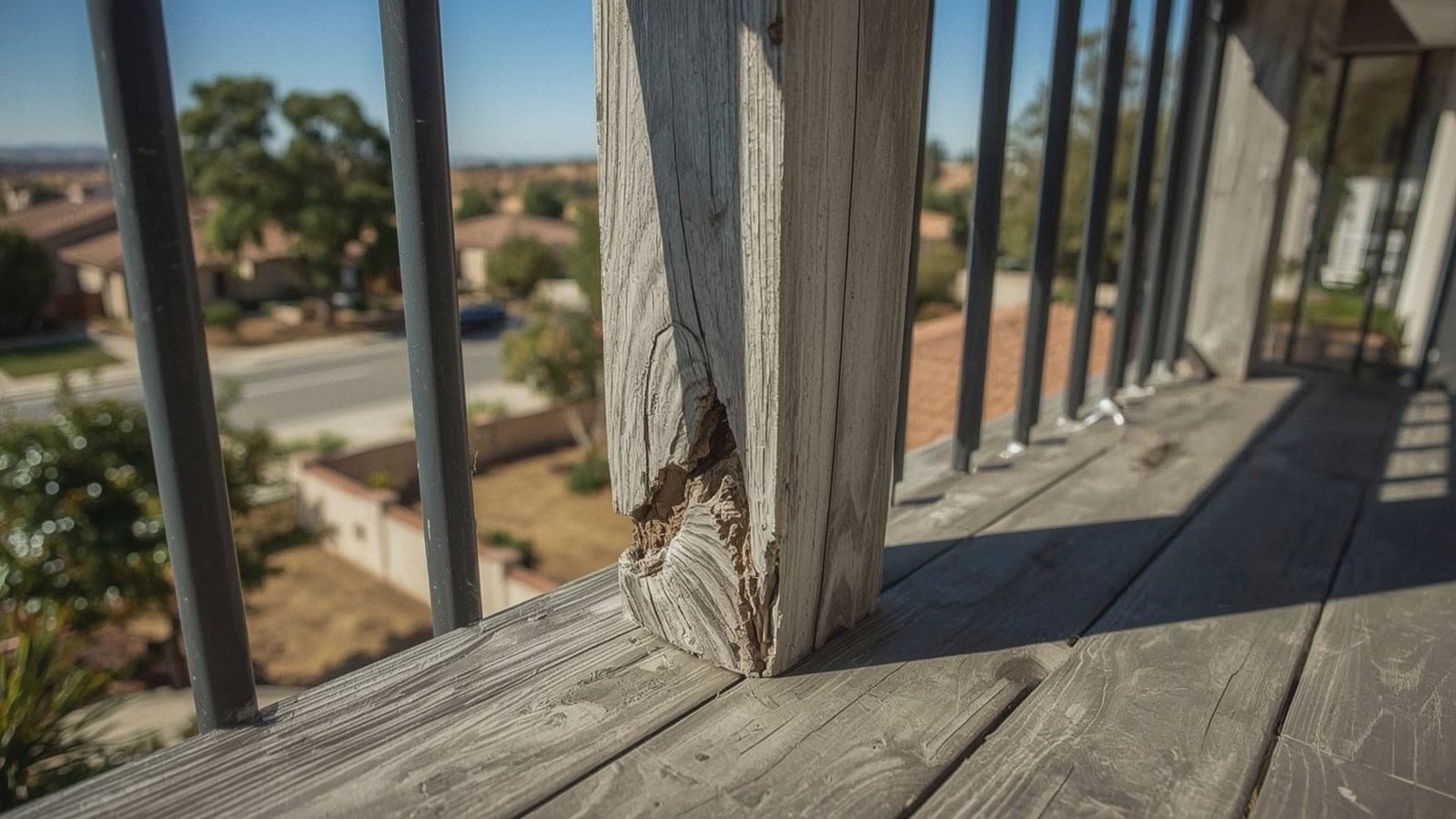
Structural Signs: Movement, Rust and Rot
- The rail moves when you push it. A guard must resist a 200-pound concentrated load at the top under the California Residential Code. If you can see a post flex or hear it creak with a firm push, the anchorage or the framing behind it has failed.
- Rust at the post base. Water collects where an iron post meets concrete or a deck surface. Flaking, swelling or rust stains running down a step mean the steel is losing thickness right where the load concentrates.
- Cracked or broken welds. Look at the joints where pickets meet the rails and where posts meet base plates. A hairline crack with rust bleeding out is a broken weld, not a paint problem.
- Soft or split wood. Press a screwdriver into wood posts near the deck surface and at the rim joist. If it sinks in, there is rot. Splits running through bolt holes are just as serious.
- Spalled concrete around anchors. When steel rusts inside concrete, it expands and pops chunks off the step or balcony edge. That leaves the post anchored in cracked material.
Any one of these is reason enough to keep weight off the rail until it is checked. Railings fail suddenly, usually when someone leans or falls against them.
Planning a railing project in San Jose or the South Bay? We measure on site for free and give you a written range before anything is fabricated.
Infill, Height and Hardware Signs
- Loose or missing balusters. A picket that spins or slides lets a gap open. Code openings must not pass a 4-inch sphere, so one missing baluster can create a gap a toddler fits through.
- A guard that is too low. Many 1960s and 1970s homes have 36-inch guards built under earlier rules. Current California code calls for 42 inches where the walking surface is more than 30 inches above grade.
- Wide picket gaps. Older iron railings often have 5 or 6-inch spacing or horizontal rails that work like ladder rungs.
- Sagging cable. On cable railings, cables that bow apart when you spread them by hand have lost tension. Slack cable can open past the 4-inch limit.
- Loose glass or failing clamps. Glass panels that rattle, shifted gaskets, or cracked or chipped edges need attention right away.
Signs 7 and 8 are not damage. They are a railing that met the rules when it was built. They still matter if young children use the deck, and they matter for the repair decision below.
A Two-Minute Railing Check
You don't need tools to do a first pass:
- Grip the top rail at each post and push outward firmly. Nothing should move.
- Run a hand along the top rail and feel for loose joints, splinters or sharp rust.
- Hold a 4-inch item (a soup can is close) against the infill and see whether it slips through.
- Measure from the deck surface to the top of the guard. Under 42 inches on a high deck is worth noting.
- Look at every post base for rust, rot, or cracked concrete.
- On stairs, check that the handrail is continuous and sits 34 to 38 inches above the stair nosings.
Write down what you find, take photos and send them with your estimate request. It speeds up the conversation and helps us bring the right parts to the visit.
Repair or Replace: How We Decide
Not every problem calls for a new railing. This is how we usually weigh it:
| Condition | Usual answer | Why |
|---|---|---|
| One or two loose posts, sound steel | Repair | Re-anchor with new through-bolts or epoxy anchors |
| Rust at a few post bases | Repair | Cut out bad steel, weld in new base sections, refinish |
| Broken welds at pickets | Repair | Grind and re-weld, then touch up the coating |
| Slack cable | Repair | Re-tension; replace fittings if corroded |
| Rust through the rails in many places | Replace | Patching costs more than new steel |
| 36-inch guard on a high deck | Replace or extend | Bring it up to 42 inches |
| Rotted wood posts and rim joist | Framing repair, then new railing | A railing is only as strong as what it bolts to |
One rule of thumb to know: replacing more than about half of an existing guard is commonly treated as a replacement that must meet current code. Verify with your building division, but plan for 42 inches and 4-inch spacing on any major rebuild.
When a Railing Repair Needs a Permit
Simple fixes like re-welding a picket or refinishing rust usually don't involve the city. Structural work can. San José's Decks page says a deck installation, replacement or repair needs a permit when the deck is 200 square feet or larger, 30 inches or more above ground at any point, attached to the house, serves a required exit door or serves as a door landing.
San José's 2025 residential guidebook also shows what the city expects behind a wood-deck guard post: at least a double 2x10 and full-depth blocking extending at least 16 inches. If your posts are lag-screwed to a single rotting rim joist, repairing the rail without fixing that connection only hides the problem.
For apartments and condos, failed railings on elevated wood-framed balconies may also be flagged in SB 721 or SB 326 inspections. See our SB 721 balcony inspection guide for the timelines.
A Seasonal Inspection Calendar
| When | What to check |
|---|---|
| October, before the rains | Seal wood tops, touch up chipped powder coat, clear leaves from post bases and drains |
| After the first heavy storm | Look for standing water at post bases and rust stains on concrete |
| April, as rain tapers off | Push-test every post; check cable tension and glass clamps |
| Mid-summer | Look for new checks and loose screws in wood rails after the dry months |
| After any noticeable earthquake | Push-test posts and look for new cracks at anchors and welds |
A fresh coat of paint over rust only hides it for a season. If the coating is failing at the bases, the steel underneath needs to be cleaned to bare metal or replaced.
Book a Free Railing Check
We repair and replace iron, steel, aluminum, cable and glass railings across San Jose and Santa Clara County. Start with our railing repair page, see replacement options on our wrought iron railings and deck railings pages, or review the height and spacing rules in our California railing code guide. Then call (408) 409-8723 for a free on-site assessment and a written repair-or-replace recommendation.
FAQ
Questions, Answered
Straight answers on cost, code, permits and materials. Still unsure? Call and ask.
How do I know if a wobbly railing is dangerous?
Any visible movement at a post when you push the top rail means the anchorage or framing has weakened. Guards are designed to hold a 200-pound load at the top. Keep people from leaning on it and have it inspected.
Can a rusted iron railing be repaired?
Often, yes. If the rust is limited to post bases or a few joints, we cut out the damaged steel, weld in new sections and refinish. If rust has eaten through rails in many places, replacement is usually cheaper and lasts longer.
My railing is 36 inches tall. Do I have to replace it?
Not just because it is 36 inches. Older homes often have guards built under earlier rules. But if you replace more than about half of the guard, it is commonly treated as new work that must meet the current 42-inch height. Confirm with your building division.
How often should I inspect my railing?
A quick check twice a year works for most homes: once in October before the rains and once in April after them. Also check after any earthquake you feel.
Need Help in San Jose?
San Jose Custom Railing builds custom iron, cable, glass and aluminum railings across San Jose, CA and the South Bay. If this guide answered your question, the next step is a free on-site measure and a written range. See everything we do on our homepage, or reach out now.